



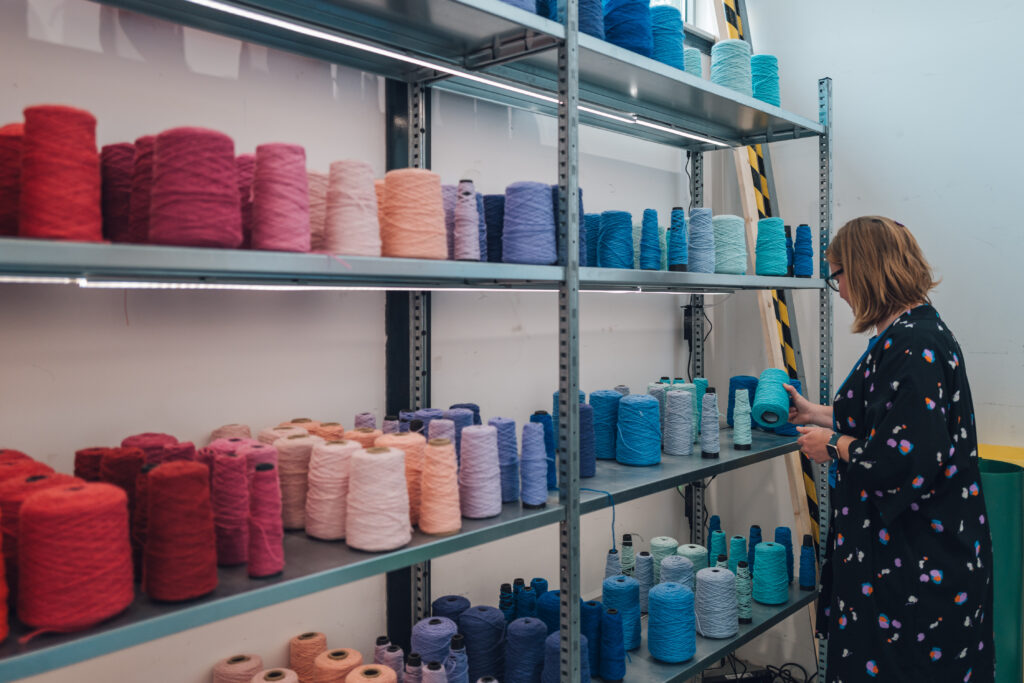
Planning yarn stock is the most common question we get from workshop operators. Order too little and a participant runs out of white halfway through a rug. Order too much and your cash sits on a shelf in cone form.
This guide gives you the actual numbers. Not estimates: real consumption data from our own workshop studio, where we have run over 1,000 workshops for more than 5,000 participants.
The quick answer
Budget 1.3 cones of yarn (650 grams) per participant for a 45x45cm workshop piece, cut pile at 14mm, tufted with two strands. That is not an estimate: it is our measured average across a thousand-plus workshops. For stock planning, round up to 1.5 cones per participant to cover variation between designs.
For a full studio, that works out to roughly 60 to 75 kg of yarn per month at the volume we run. Scale that up or down based on your participant count, and add a buffer. The full calculation is below.
Yarn usage per rug size
Textbook figures for cut pile at a typical pile height of 14mm sit around 2 to 2.5 kg of yarn per square metre. Our workshop data tells a different story: measured across real beginner pieces at 14mm pile height with two strands, consumption lands at around 3.2 kg per square metre, all-in. The gap is beginner reality: denser tufting, mistakes, re-tufting and colour changes.
Plan workshop stock on the measured rate, not the textbook one:
| Piece size | Tufted area | Yarn needed (workshop) |
|---|---|---|
| 30x30cm | 0.09 m² | ~300g (0.6 cone) |
| 40x40cm | 0.16 m² | ~500g (1 cone) |
| 45x45cm | 0.20 m² | ~650g (1.3 cones, our measured average) |
| 50x50cm | 0.25 m² | ~800g (1.6 cones) |
| 60x60cm | 0.36 m² | ~1.2 kg (2.3 cones) |
| 100x100cm | 1 m² | ~3.2 kg (6.5 cones) |
Two notes on these numbers:
Loop pile uses less. Expect around 30% less yarn than cut pile at the same size, since no material is trimmed away during shaving. But first time users struggle with loop pile.
Experienced tufters use less too. Working alone on your own designs, you will land closer to the 2 to 2.5 kg/m² range. The table above is calibrated for workshop conditions with first-time tufters.
What 1,000+ workshops taught us about consumption
At our workshop, participants tuft on 80x80cm primary cloth, with a design area of around 45x45cm. The finished pieces get a 60x60cm anti-slip backing.
Our measured average: 1.3 cones (650g) per participant. At studio level, that adds up to around 125 to 150 cones per month, or 60 to 75 kg of tufting wool, covering all workshop formats, colour testing and the inevitable waste that comes with beginners handling a tufting machine for the first time.
If you know your monthly participant count, your baseline is simple:
Monthly yarn stock = participants per month × 0.65 kg × 1.15 buffer
So a studio running 40 participants a month needs around 30 kg (60 cones) on hand. At 100 participants, you are at 75 kg (150 cones).
Colour planning: where operators go wrong
Total volume is only half the equation. The colour split matters just as much, and this is where most new operators misjudge.
Our purchasing data across 30+ colours is consistent:
- Black is the single highest-consumption colour. We stock it at 4x the volume of any accent colour. Outlines, text and dark backgrounds eat black yarn.
- White is a close second, at roughly 3x accent volume. It is the default background colour in most beginner designs.
- Red and yellow run about 30% above other accents.
- Every other colour is roughly equal. Pinks, greens, blues, purples and neutrals all consume at a similar, much lower rate.
A practical starting split for a new workshop studio ordering 100 cones:
| Colour group | Share |
|---|---|
| Black | 15-20 cones |
| White | 12-15 cones |
| Greys, beiges, browns | 15-20 cones |
| Red, yellow, orange | 12-15 cones |
| All other accents (pink, green, blue, purple) | 35-40 cones, spread evenly |
One more lesson from our own stock counts: the colours that run out first are never the ones you expect to be exciting. Neutrals and basics empty the shelf. Order accents in small, even quantities and reorder based on what actually moves.
Cap designs at 5 colours. We advise every participant to use a maximum of 5 colours per design. The reason is time: a participant who is still correcting colour number five at the end of the session runs out of clock. The side effect is good for your stock too: fewer colours per piece means fewer opened cones sitting half-used on the shelf.
Why we run our workshops on wool
Our workshops run on wool, and that is a quality decision. Wool shaves to a cleaner, denser finish than synthetic alternatives, and the finished piece is what participants photograph, share and remember. When the rug someone takes home is your marketing, the yarn choice is not the place to save money.
The consumption figures in this guide are measured on our tufting wool, the same 500g cones we sell in the webshop.
However, most workshops run on acrylic or polyester tufting yarn, simply because of the costs involved. Depending on your angle with the classes, it is perfectly fine to offer acrylic.
One caution: acrylic is plastic, and the carving and shaving phase releases fine synthetic fibres into the air. Make sure your studio has good airflow, ideally with extraction near the shaving station, and consider dust masks for anyone doing the finishing work. You do not want participants or staff breathing in plastic fibres all day.
Lead times: order before you need it
Yarn stock-outs are the one supply problem you cannot fix on short notice mid-workshop-season. We plan our own stock in cycles of roughly 160 days and count inventory monthly. For a workshop business, three habits prevent most problems:
- Count monthly. Ten minutes with a clipboard tells you your real consumption rate per colour, which beats any generic formula, including ours.
- Reorder at 60 days of remaining stock, not when the shelf looks empty. Black and white first.
- Plan around your local peak season. Workshops fill up around holidays, precisely when you want to be open and when suppliers slow down. Order your holiday-season stock well before the peak starts, not during it.
Buying yarn as a workshop operator
If you run tufting workshops, you should not be paying retail prices for consumables. Our Workshop Supplies Program gives approved workshop operators wholesale pricing on wool, tufting cloth, backing and accessories: the same stock we run our own workshops on.
Apply with your studio details and we review every application manually. Approved accounts order directly through the webshop at their own price tier.
Off The Frame: what you made, October 2026
Off The Frame: what you made, September 2026
Wool vs Polyester for Tufting – which yarn should you use?
Introducing Ultra-Vivid: Polyester Tufting Yarn
Creating Fluffy, High-Pile Contrast in Your Rugs
How Much Yarn Do I Need for My Tufting Project?
How Much Yarn Do You Need for Tufting Workshops?
Fabio Passeri’s Tibetan Celestial Dragon