

Almost every first rug has a line you would like to do again, or a patch that looks a little uneven. The good news is that most of this is fixable while the work is still on the frame, and before you glue the back.
The easiest fixes start with good technique: if you outlined first and filled with the grid of the cloth, you can usually pull a line and tuft it again. If you have been tufting on a diagonal or in tight curves, take more care: the cloth is more likely to suffer. See how to move your tufting machine over the canvas and the basic tufting rules.
Only undo stitches before you glue the back. Once the glue is dry, the stitches are locked in. Do not glue until you are happy with the front.
Before you pull anything
- Unplug the tufting machine and set it aside.
- Look at the cloth. If you already see a run, a hole, or a thin, shiny patch, stop and read what to do if your backing cloth tears before you pull more yarn.
- Work on one short section at a time. You rarely need to undo a whole colour.
How to undo a line
If you tufted with the grid (straight vertical or horizontal rows), the fabric usually recovers well when you remove yarn.
- Pull the yarn out from the tufting side: that is the back of the rug, the side you have been working on. Take the end of the yarn and pull it out slowly and evenly. Do not yank.
- Support the cloth with your other hand so it does not jump off the grippers.
- Once the yarn is out, look at the holes. They should close back up. If the cloth looks stretched, thinned or torn, do not keep pulling at that spot.
- Re-stretch the cloth on the frame if it has loosened, then tuft the line again, at a steady pace, next to or on the same path.
If the line was tufted on a curve or a diagonal, the yarn may be more tangled in the weave. Pull even more slowly. If the cloth starts to give, leave the remaining stitches and tidy the front later with shears or clippers instead of forcing the yarn out.
Gaps, thin spots and cloth showing through
A thin line or a glimpse of cloth between rows is usually a spacing issue, not a broken machine.
- Tuft an extra pass next to the thin area, in the same direction as the surrounding rows.
- Keep the pace steady. A sudden fast burst will look different from the rows beside it.
- Do not punch the same holes over and over. Add yarn beside the existing stitches, not on top of damaged cloth.
If cloth still shows after a careful second pass, you can often hide a small gap later when you carve and shave the front. Large gaps are better filled while the work is still on the frame.
Uneven pile
The most common cause of patchy, uneven pile is an inconsistent speed: slowing down or speeding up mid-section, or lifting the gun as you go. That is much easier to prevent than to fix. See the technique basics.
Once the whole design is tufted, you can still tidy the front:
- Trim individual high loops or stray ends with duckbill napping shears. The curved blade sits flat on the surface, so you are less likely to gouge the pile.
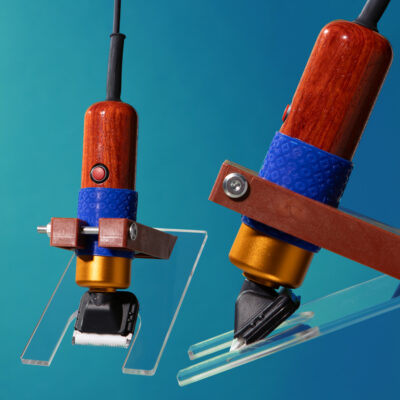
- For a larger area, use rug shaving and carving clippers to even the surface, then carve the edges of your shapes. See how to carve a tufted rug and our shaving and carving tools.
Shaving will not fix a line in the wrong colour, and it will not repair a tear. Use it to even and sharpen, not to hide a structural mistake.
If a small hole appears in the cloth
Sometimes a hole opens in the cloth when you pull yarn, or after a stitch has stressed the weave. Keep the repair simple:
- Stop pulling at that spot. Do not stretch or tug the cloth further, and do not keep tufting into the damaged weave.
- Re-tension the surrounding cloth on the grippers if it has loosened, so the hole does not open wider.
- For a very small hole, you can often work around it: leave a margin of intact cloth and continue the design beside it. Tidy the front later with shears if a few ends sit proud.
- If the hole is growing, the weave looks thin or shiny, or you are not sure the cloth will hold, stop and follow what to do if your backing cloth tears.
We do not describe a patch or stitch-the-cloth repair here. Protecting the cloth, and using the tear guide for anything more than a tiny hole, is the safer next step.
When to stop and start again on that section
Stop pulling or re-tufting a spot if:
- the cloth has torn, or a hole is opening
- the weave looks shiny, thin or distorted
- yarn keeps falling out of the same area after you refill it
In those cases, protect the cloth first. The backing-cloth tear guide covers what to do next.
A first rug does not have to be perfect. Clean outlines, even rows and a careful shave at the end will do more for the finished piece than chasing every stitch.